
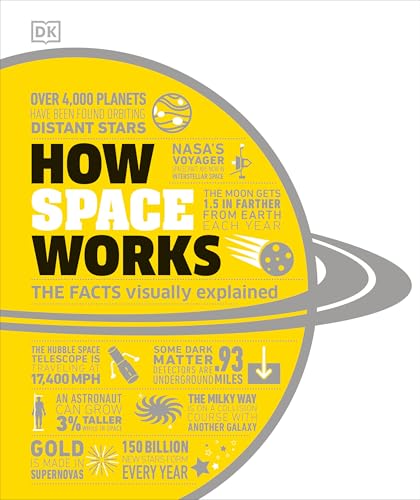
How space works / [contributors, Abigail Beall, Philip Eales, John Farndon, Giles Sparrow, Colin Stuart ; editors, Annie Moss, Hannah Westlake].
Material type: TextSeries: Facts visually explainedPublisher: New York : Dorling Kindersley Limited, 2021Edition: First American editionDescription: 223 pages : color illustrations ; 24 cmContent type:
 - text
- still image
- unmediated
- volume
- 9780744027488
- 9780241446324
- How space works : the facts visually explained [Cover title]
- QB500.262 .H68 2021
| Cover image | Item type | Current library | Home library | Collection | Shelving location | Call number | Materials specified | Vol info | URL | Copy number | Status | Notes | Date due | Barcode | Item holds | Item hold queue priority | Course reserves | |
|---|---|---|---|---|---|---|---|---|---|---|---|---|---|---|---|---|---|---|
 Books
Books
|
Grade School Learning Resource Center Reference | REF 520 M9131 2021 (Browse shelf(Opens below)) | 1 | Available | GS20106 | |||||||||||||
|
Books
|
High School Learning Resource Center General Circulation | QB 500.262 H68 2021 (Browse shelf(Opens below)) | 1 | Available | HS14529 |
Browsing Grade School Learning Resource Center shelves,Shelving location: Reference Close shelf browser (Hides shelf browser)

|

|

|

|

|

|

|
||
| REF 513.21 W89311 2012 Fun with numbers. | REF 513.211 M629 2022 Addition / | REF 516 W89311 2012 Fun with shapes. | REF 520 M9131 2021 How space works / | REF 520.3 Sp11 2019 Space. | REF 523 H8741 2012 Little kids first big book of space / | REF 523 W89311 2012 Learning about the sun, moon, planets, and stars. |
Includes index.
"The facts visually explained" -- Cover.
Space from Earth -- The Solar System -- Stars -- Galaxies and the Universe -- Space exploration.
How the Universe works - and how we explore it - explained in simple words and clever graphics. The clearest, most visual guide to space and the Universe for complete beginners to astronomy. Have you ever asked yourself how big the Universe is, how far it is to the nearest star, or what came before the Big Bang? Then this is the book for you. How Space Works shows you the different types of object in the Universe (so you'll know your pulsars from your quasars) and introduces you to some of the strangest and most wonderful things known to science, including dark matter particles and ancient white dwarf stars that are almost as old as the Universe itself. The book starts with an explanation of our view of the Universe from Earth, then takes a tour of the Solar System, the stars and galaxies, and the furthest reaches of space. The last chapter looks at the technology we use to explore the Universe, from the International Space Station to Mars rovers and the new and revolutionary reusable rockets. Illustrated with bold graphics and step-by-step artworks - and peppered with bite-sized factoids and question-and- answer features - this is the perfect introduction to astronomy and space exploration.-- Source other than the Library of Congress.
There are no comments on this title.