
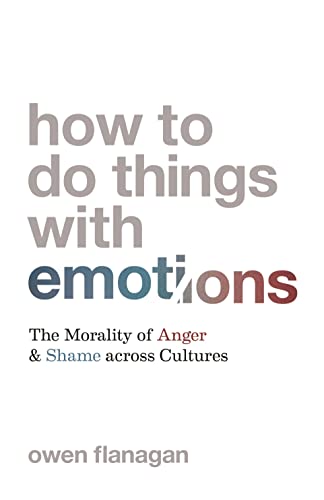
How to do things with emotions : the morality of anger and shame across cultures / Owen Flanagan.
Material type: TextPublication details: Princeton : Princeton University Press, 2023.Description: xiv, 309 pages ; 22 cmISBN:
 - 9780691220994
- BJ1535 .A6 F53 2023
| Cover image | Item type | Current library | Home library | Collection | Shelving location | Call number | Materials specified | Vol info | URL | Copy number | Status | Notes | Date due | Barcode | Item holds | Item hold queue priority | Course reserves | |
|---|---|---|---|---|---|---|---|---|---|---|---|---|---|---|---|---|---|---|
 Books
Books
|
College Learning Resource Center General Circulation | CIR BJ1535 .A6 F53 2023 (Browse shelf(Opens below)) | 1 | Available | CL12792 |
Includes bibliographical references (pages 287-300) and index.
"The world today seems full of anger. In the West, particularly in the US and UK, this anger can oftentimes feel aimless, a possible product of social media. Still, anger is normally considered a useful motivational source for positive social change. Channeling that anger into movements for civil rights, alleviation of socio-economic inequality, and the end of endless wars, has long been understood as a valuable tactic. Moreover, anger is believed to be handy in everyday life in order to protect, and stick up for, oneself. On the flip side, the world today celebrates diminishing amounts of shame. Political leaders and pundits shamelessly abandon commitments to integrity, truth and decency, and in general, shame is considered to be a primitive, ugly emotion, which causes eating disorders, PTSD, teenage pregnancy, suicide, and other highly undesirable circumstances. Having shame is, thus, regularly understood as both psychologically bad and morally bad. In How to Do Things with Emotions, philosopher Owen Flanagan argues this thinking is backwards, and that we need to tune down anger and tune up shame. By examining cross-cultural resources, Flanagan demonstrates how certain kinds of anger are destructive, while a 'mature' sense of shame can be used--as it is in many cultures--as a socializing emotion, that does not need to be attached to the self, but can be called upon to protect good values (kindness, truth) rather than bad ones (racism, sexism). Drawing from Stoic, Buddhist, and other cultural traditions, Flanagan explains that payback anger (i.e., revenge) and pain-passing anger (i.e., passing hurt one is feeling to someone else) are incorrigible, and also, how the Western view of shame rooted in traditions of psychoanalysis is entirely unwarranted. Continuing his method of doing ethics by bringing in cross-cultural philosophy, research from psychology, and in this case widening that to include cultural psychology and anthropology, Flanagan shows exactly how our culture shapes our emotions--through norms and traditions--and how proper cultivation of our emotions can yield important progress in our morality". Provided by publisher.
There are no comments on this title.